
Nobody expects an update to Psypan
Auburn Sounds is proud to release Psypan 2, a supercharged stereo tool that revisits the original Psypan. Reading time = 4 min.
What's Psypan 2?
Psypan 2 (out now!) is a multi-effect audio plug-in that handles all sorts of stereo duties with its 17 pan modes.
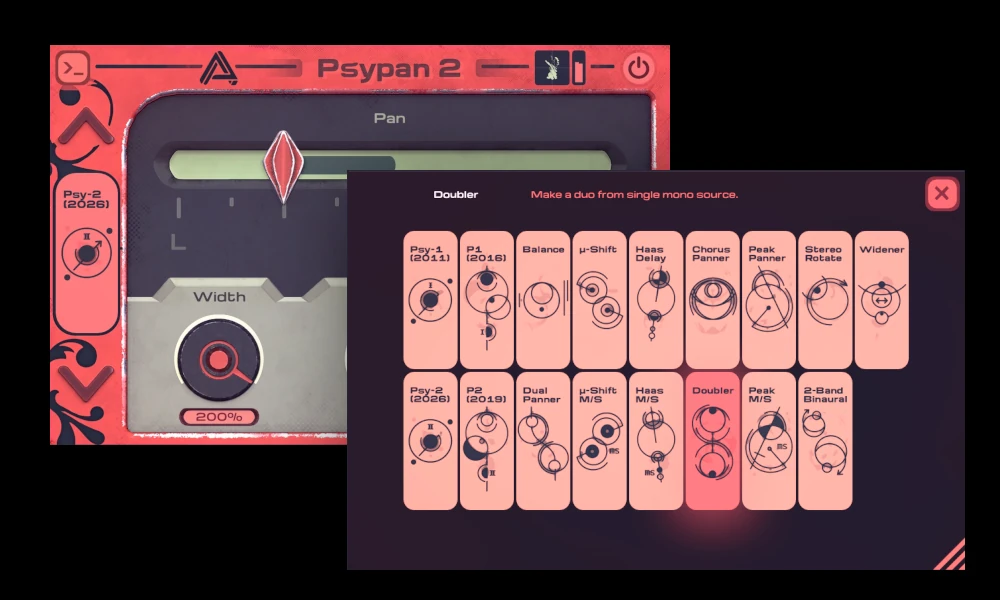
Whatever you want to do with the stereo field, there is probably something for you in Auburn Sounds Psypan 2.
The old GFM Psypan binaural panner (2011)
Before Auburn Sounds even existed, we made GFM Psypan 1.0, a simple linear-phase binaural panner plug-in.
Trivia: GFM stands for Games From Mars.
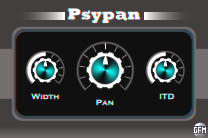
Nowadays, some professional mixers are still using GFM Psypan, 15 years after its release.
This is strange, since Panagement was designed as a successor to Psypan with its new binaural panning and distance modeling.
So, there was something in the original Psypan binaural panning that was desirable and forgotten.
When accidental bugs sound just fine (Psy-1)
Here is what we found after analysis:
GFM Psypan is a strictly linear-phase binaural panner with 64-point
sincinterpolation, which performs better in the presence of transients than Panagement's more latency-conscious polynomial interpolation.GFM Psypan changes volume by -0.65 dB. This likely accidental bug helps because the track is being binaurally panned anyway, making it pop out of the mix.
GFM Psypan reports less latency than it actually introduces. This has the fortunate effect of shifting the sound back temporally once Plugin Delay Compensation deals with it. This is conceptually ugly, yet we have found this lag to be a positive for the mix in almost all our tests.
In Psypan 2, that legacy pan mode is included as-is and called Psy-1, in case you want strict linear-phase operation.

An updated algorithm (Psy-2)
So immediately we knew we could improve this panner by turning everything into 64-bit double precision, upping the number of taps to 128, and keeping those two weirdly desirable bugs, but tuned.
Thus was born the Psy-2 algorithm. Psy-2 is also spectrally active with IIR at the cost of strict phase-linearity.
If you don't filter along with panning angle, then the sound seems to pass over your head at low pan angles, as happens with Panagement. Psy-2 simply adds hand-tuned EQ curves that allow the angular direction to be felt more precisely, and also the perceived sound image now moves in front of the listener, not above.
You can feel a true rotation in front of you with Psy-2, even without other spatial cues. That, of course, feels great when coupled with a pre-reverb.

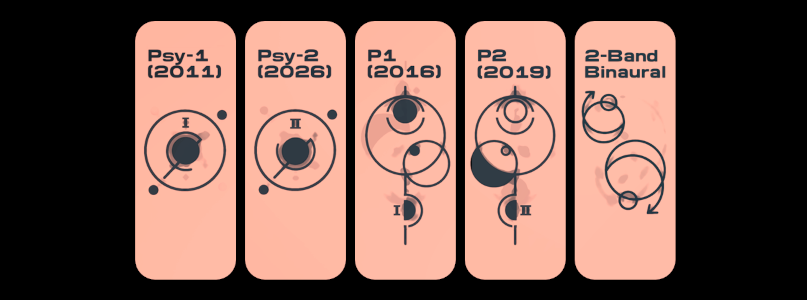
5 modes for binaural panning
Each binaural panner in Auburn Sounds Psypan 2 has slightly different curves and characteristics.
- Psy-1 is the unmodified GFM Psypan algorithm.
- Psy-2 is the new binaural panner we recommend for realism and immersion.
- P1 (Full Edition only) is the unmodified Panagement 1 algorithm, without distance modeling.
- P2 (Full Edition only) is the unmodified Panagement 2 algorithm, without distance modeling.
- 2-band Binaural is a two-band Psy-2, to keep bass content centered.
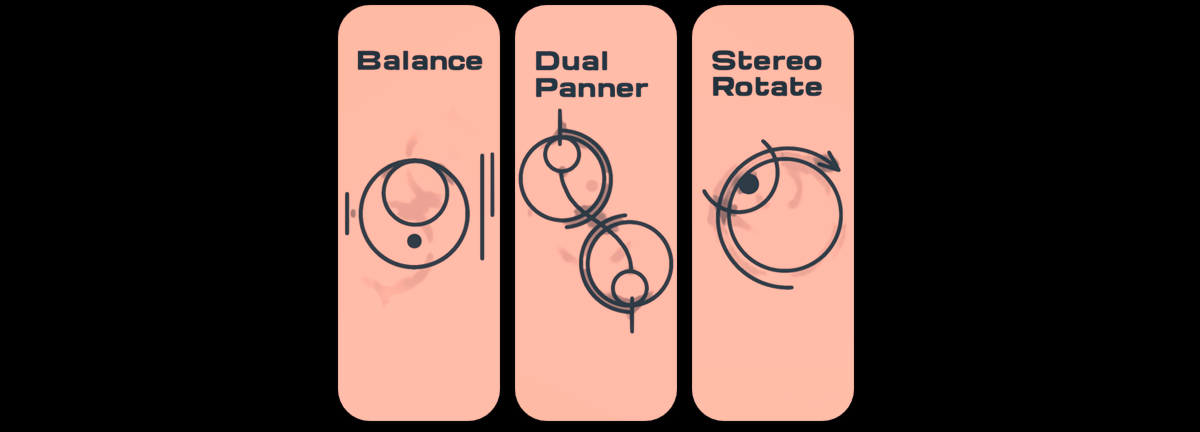
3 modes for channel balance
However, binaural panning ought to be more the exception than the rule, and we'd prefer not to steer people in the wrong direction.
At this point we thought it would be honest to include a more standard Balance pan, and a Dual Pan mode for comparison.
Balance pan is like your regular DAW pan, and features 3 pan laws:
- Compensated -3 dB center (most DAWs)
- Compensated -4.5 dB center (Logic, SSL...)
- Compensated -6 dB center
We also introduce a rather uncommon Dual Stereo Rotation control. To be entirely honest it takes some getting used to, and we're not yet sure where it shines.
Those 3 modes only introduce volume changes and don't introduce phase changes or delays. A lot of modes in Psypan 2 also have Stereo Width as a preprocess, which needs no explanation.
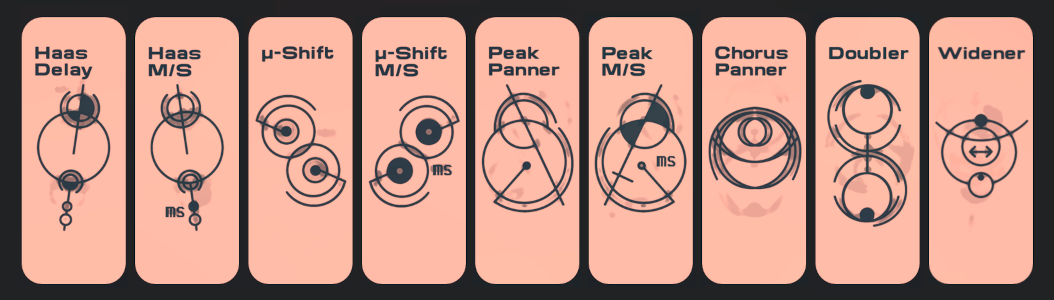
9 creative modes you may need
The remaining 9 modes introduce delays to change the perceived size of a source and typically make it "wetter". Those are to be reached for when you would want a chorus, a slight reverb, something unnaturally large, or to make something fit in the mix.
- Haas Delay along with a rarer M/S Haas Delay (Full Edition only) version. Functionally, this is like binaural panning with a larger delay (up to 200 milliseconds).
- µ-shifting along with a brand new M/S µ-shifting (Full Edition only) which roughly serves the purpose of a Chorus (which is also included) by combining pitch-shifting and delays.
- Peak Panner and M/S Peak Panner (Full Edition only) are inspired by a well-known "directional" equalizer plug-in and provide decramped Ivantsov peak EQ for L, R, M or S signals.
- Doubler (Full Edition only) is a wetter Haas that is appropriate for doubling an instrument.
- Widener is a fake stereo generator algorithm, using modulated allpasses in series.
One plug-in to bind them all
Auburn Sounds Psypan 2 is a unique effect which allows you to quickly test various stereo algorithms when confronted with the need to add life and movement to a mix.
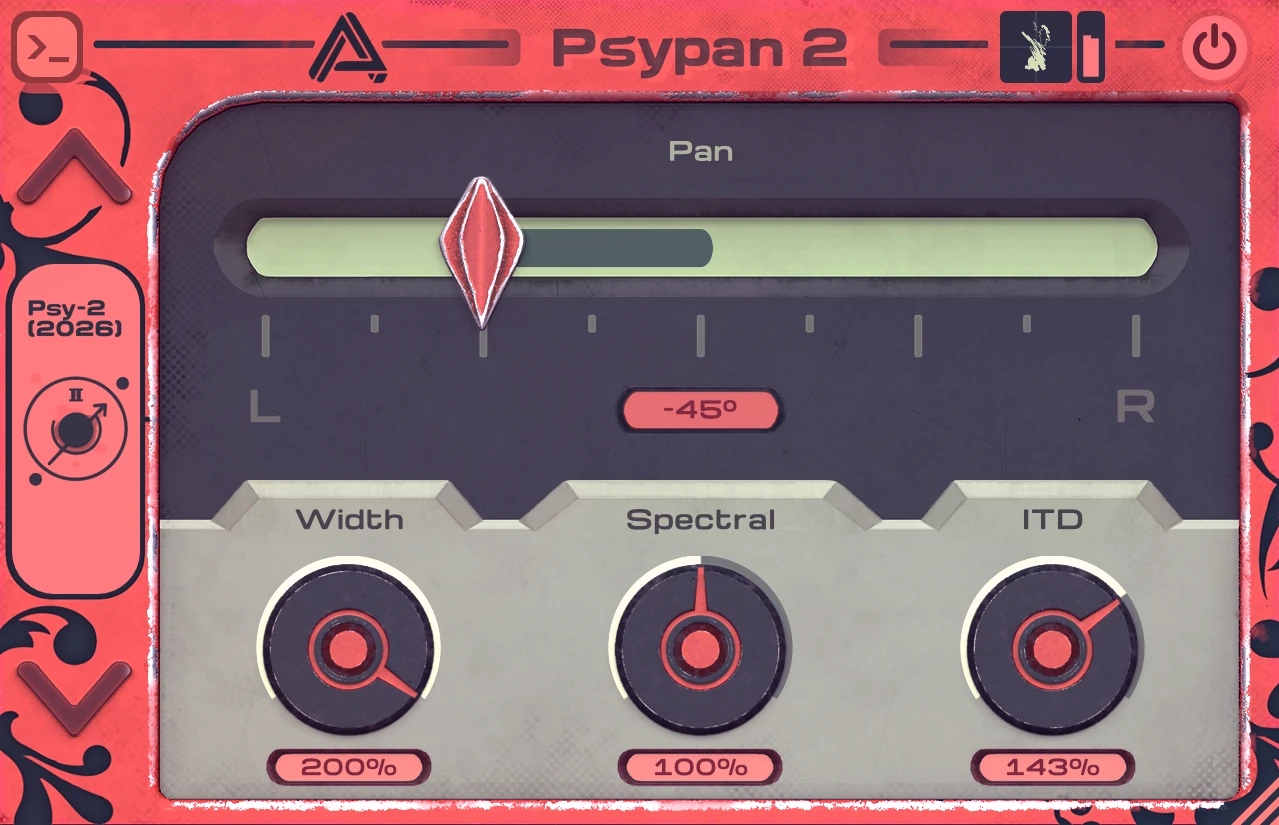
Like all Auburn Sounds plug-ins, Psypan 2 comes in two editions:
- Psypan 2 Free Edition offers 10 pan modes.
- Psypan 2 Full Edition offers all 17 pan modes, for just $38.67 MSRP ($29 until 15th August 2026).
Psypan 2 transcends its initial design as a binaural panner and becomes more useful for your mixes, without overthinking it. Just pan and browse the possibilities in the multi-mode menu.
Compatibility: Windows, Linux, and macOS. VST, AU, CLAP, AAX, LV2, FLP formats.